Bankroll Management: How Much Should You Bet?
Bankroll management is one of the most important parts of football betting, especially for anyone who wants to bet regularly. While many bettors focus on finding good football predictions, odds and betting strategies, it is equally important to know how much money to risk on each bet.
A good prediction can still lose. Football is unpredictable, and there is no strategy that can guarantee a winning result every time. Proper bankroll management helps you control your losses, avoid emotional decisions and keep your betting activities within an amount you can afford.
What Is a Betting Bankroll?
 Good bankroll management helps bettors control their stakes and manage the financial risks of football betting.
Your betting bankroll is the amount of money you have specifically set aside for football betting.
For example, if you decide to set aside ₦100,000 for betting, that ₦100,000 becomes your bankroll.
It is important to separate your betting bankroll from money you need for everyday expenses. Your rent, food, school fees, bills, savings and other important financial commitments should not be part of your betting bankroll.
The idea is simple: only bet with money you can afford to lose.
How Much Should You Bet Per Match?
There is no single amount that is suitable for everyone.
A common approach to bankroll management is to risk a small percentage of your bankroll on each selection rather than using a fixed large amount.
For example, if your bankroll is ₦100,000:
Using a smaller percentage means that a losing bet will have a limited effect on your overall bankroll.
For many bettors, 1% to 3% per selection can be a more conservative starting range. However, this is not a guarantee of profit and should not be treated as a universal rule.
Why Small Stakes Can Be Better
Imagine you have ₦100,000 and decide to stake ₦20,000 on one football match.
If the bet loses, you immediately lose 20% of your bankroll.
Now imagine staking ₦2,000 instead.
If that bet loses, you still have ₦98,000 remaining.
This difference becomes particularly important during losing streaks.
Even experienced bettors can have several losing selections in a row. Smaller stakes give your bankroll more room to recover.
Avoid Betting Your Entire Bankroll
One of the biggest mistakes a bettor can make is putting most or all of their bankroll on one match.
You may be very confident that a particular team will win, but confidence does not guarantee the result.
A favourite can lose because of:
- A red card
- An injury
- A penalty
- Poor finishing
- A tactical mistake
- An unexpected performance
- A late goal
Football can change very quickly, which is why putting your entire bankroll on one prediction is extremely risky.
Should You Increase Your Stake After Winning?
Winning a bet can make you feel more confident, but that does not mean you should immediately increase your stake significantly.
For example, if your normal stake is ₦2,000 and you win ₦4,000, there is no need to suddenly place ₦10,000 on the next match.
Your next selection still has the possibility of losing.
One approach is to continue using a consistent percentage of your current bankroll. This keeps your staking more controlled and prevents one emotional decision from creating a large loss.
What About Increasing Stakes After a Loss?
Increasing your stake after losing is commonly associated with the Martingale strategy.
The idea is to increase the next stake in an attempt to recover previous losses.
For example:
- Bet 1: ₦1,000 — Lose
- Bet 2: ₦2,000 — Lose
- Bet 3: ₦4,000 — Lose
- Bet 4: ₦8,000 — Lose
A few consecutive losses can quickly turn a small initial stake into a much larger amount.
This can put significant pressure on your bankroll and encourage emotional betting.
Instead of trying to immediately recover a loss, it is generally better to accept losing bets as part of the activity and stick to your predetermined staking plan.
Bankroll Management for Accumulators
 Using a small percentage of your bankroll for each bet can help limit the impact of losing selections.
Accumulators can be tempting because a small stake can potentially produce a large return.
For example, you could combine five football selections into one accumulator.
However, every additional selection creates another opportunity for the bet to lose.
If one selection fails, the entire accumulator may be unsuccessful.
Because of this, bettors should be particularly careful about staking large amounts on accumulators simply because the potential return looks attractive.
Set a Daily or Weekly Betting Limit
Another useful part of bankroll management is setting a limit for how much you are prepared to lose within a particular period.
For example, you may decide that you will not risk more than a certain amount in one day or week.
Once you reach that limit, stop betting.
This can help prevent you from continuing to place bets because you are trying to recover earlier losses.
Keep a Record of Your Bets
Recording your betting activity can help you understand how you are performing.
You can record:
- Date
- Match
- Market
- Selection
- Odds
- Stake
- Result
- Profit or loss
For example:
After several weeks or months, you can review your records and see how your betting decisions have performed.
Don't Chase Losses
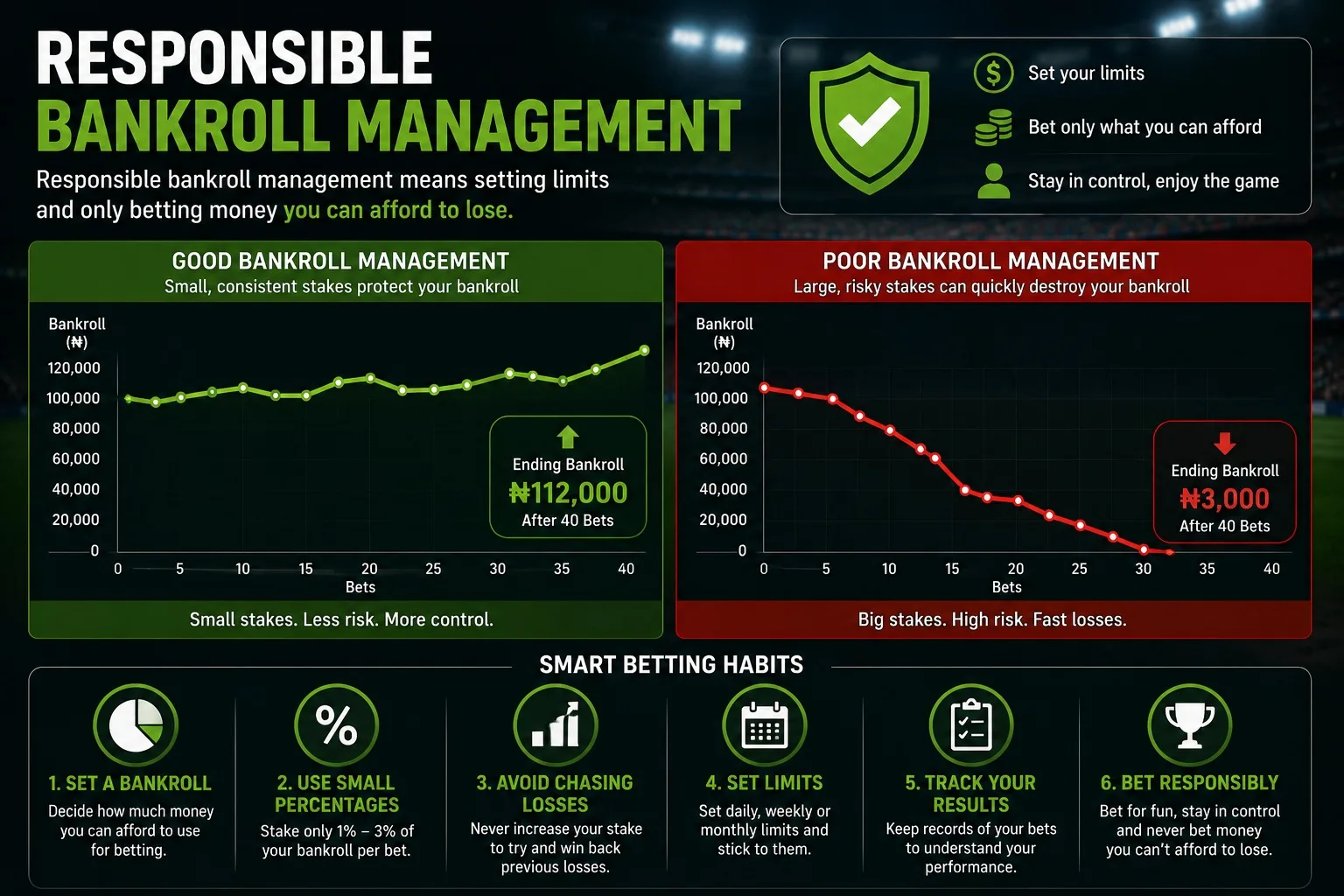 Responsible bankroll management means setting limits and only betting money you can afford to lose.
Chasing losses is one of the biggest dangers in football betting.
Suppose you lose ₦5,000. You may feel tempted to place ₦10,000 or ₦20,000 on the next match to recover the money.
The problem is that the next bet can also lose.
This can create a cycle where your stakes become larger and your losses increase.
A losing bet should not automatically determine the size of your next stake.
Does a Bigger Stake Mean Bigger Profit?
A bigger stake means a bigger potential return, but it also means a bigger potential loss.
For example, at odds of 2.00:
- ₦1,000 stake → ₦2,000 total return
- ₦5,000 stake → ₦10,000 total return
- ₦10,000 stake → ₦20,000 total return
The calculation is simple, but the risk increases as your stake increases.
The goal of bankroll management is not necessarily to maximise the amount you can win from one bet. It is to control how much you can lose when a prediction does not go your way.
Can Prediction Sites Help With Bankroll Management?
Football prediction websites can provide information that users may consider when deciding which markets to bet on.
Platforms such as Betzena can provide football predictions and analysis across different markets.
However, a prediction should never be treated as a guarantee.
Even if a prediction looks strong, the result can still go against you. Your stake should therefore be determined by your bankroll and risk tolerance, not simply by how confident you feel about a prediction.
What Is the Best Bankroll Management Strategy?
There is no single strategy that works for every bettor.
However, a disciplined approach can include:
- Set aside a specific betting bankroll.
- Only use money you can afford to lose.
- Use relatively small stakes.
- Avoid risking your entire bankroll on one bet.
- Set daily or weekly limits.
- Do not chase losses.
- Keep records of your bets.
- Avoid emotional betting.
- Review your results regularly.
- Take a break if betting becomes difficult to control.
Final Thoughts
Bankroll management is about controlling your money rather than trying to win every football bet.
Even the best football predictions can lose, so having a clear staking plan is important.
Whether your bankroll is ₦20,000, ₦100,000 or ₦1 million, the same principle applies: do not risk money you cannot afford to lose.
Using smaller stakes, setting limits, avoiding chasing losses and keeping proper records can help you approach football betting more responsibly.
There is no guaranteed betting strategy, and bankroll management cannot turn losing bets into winning ones. However, it can help you avoid unnecessary financial pressure and make more disciplined decisions.