How Football Predictions Are Made: A Simple Guide
Football predictions are everywhere today. From professional analysts and sports journalists to prediction websites and football fans, many people try to predict what will happen before a match starts.
But how are these predictions actually made?
A good football prediction is usually not based on guessing or simply choosing the bigger team. Analysts look at different types of information, including recent form, goals, injuries, team statistics, home advantage and betting odds.
No method can predict every football match correctly. The game is unpredictable, and unexpected events can change the result. However, analysing the right information can help create a more informed prediction.
What Is a Football Prediction?
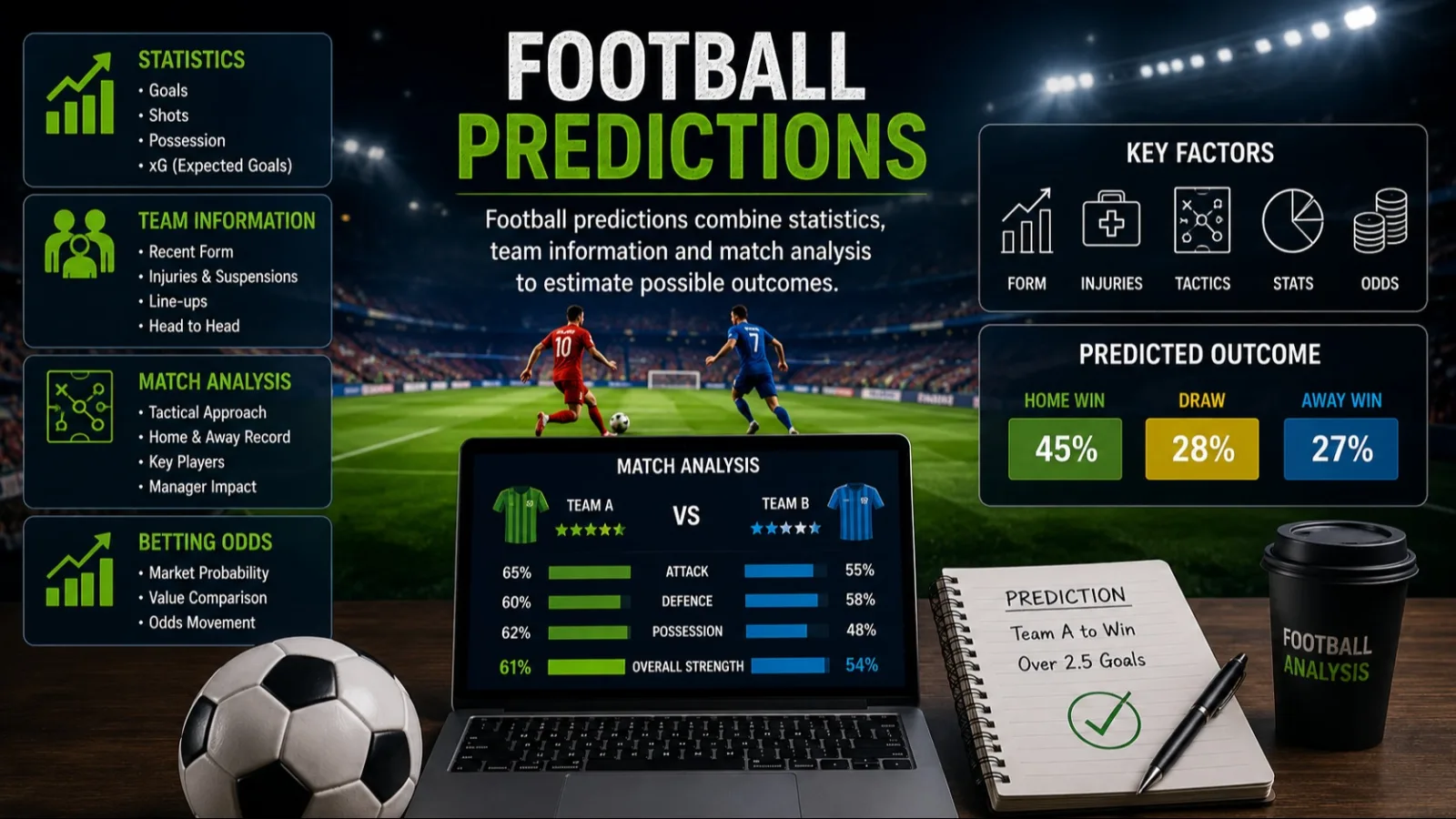 Football predictions combine statistics, team information and match analysis to estimate possible outcomes.
A football prediction is an assessment of what could happen in a football match.
A prediction could focus on several markets, such as:
- Match Result
- Double Chance
- Over/Under Goals
- Both Teams to Score
- Correct Score
- Draw No Bet
- Asian Handicap
For example, an analyst may predict that Team A will win, that both teams will score or that the match will produce more than 2.5 goals.
The prediction is based on available information rather than certainty.
1. Analysing Recent Team Form
One of the first things analysts look at is recent form.
A team's last five or ten matches can provide useful information about its current performance.
For example, an analyst may look at:
- Wins
- Draws
- Losses
- Goals scored
- Goals conceded
- Clean sheets
- Performance against strong opponents
A team that has won four of its last five matches may appear to be in good form. However, it is also important to consider who those matches were against.
Beating weaker teams does not necessarily mean a team will perform well against a strong opponent.
2. Home and Away Performance
Where a match is played can have a major influence on football predictions.
Some teams perform much better at home because they are familiar with the pitch, have support from their fans and may be more comfortable with their normal playing conditions.
Other teams may struggle when playing away.
For this reason, analysts often compare:
Home team's home record
with
Away team's away record
This information can be particularly useful when predicting Match Result, Double Chance and goals markets.
3. Goals Scored and Conceded
Goals are one of the most important statistics in football prediction.
Analysts can examine how many goals a team has scored and conceded over its recent matches.
For example, if Team A has scored an average of 2.0 goals per match while Team B regularly concedes goals away from home, this could influence predictions for the match.
Goals statistics can also be useful for markets such as:
- Over 1.5 Goals
- Over 2.5 Goals
- Under 2.5 Goals
- Both Teams to Score
However, past goal statistics do not guarantee what will happen in the next match.
4. Injuries and Suspensions
Team news is another important part of football prediction.
The absence of an important striker, midfielder or defender can change the strength of a team.
For example, if a team's main striker is unavailable, its attacking performance could be affected.
Likewise, losing an experienced central defender may make a team more vulnerable at the back.
Analysts therefore check injury reports, suspensions and expected line-ups before finalising a prediction.
5. Head-to-Head Records
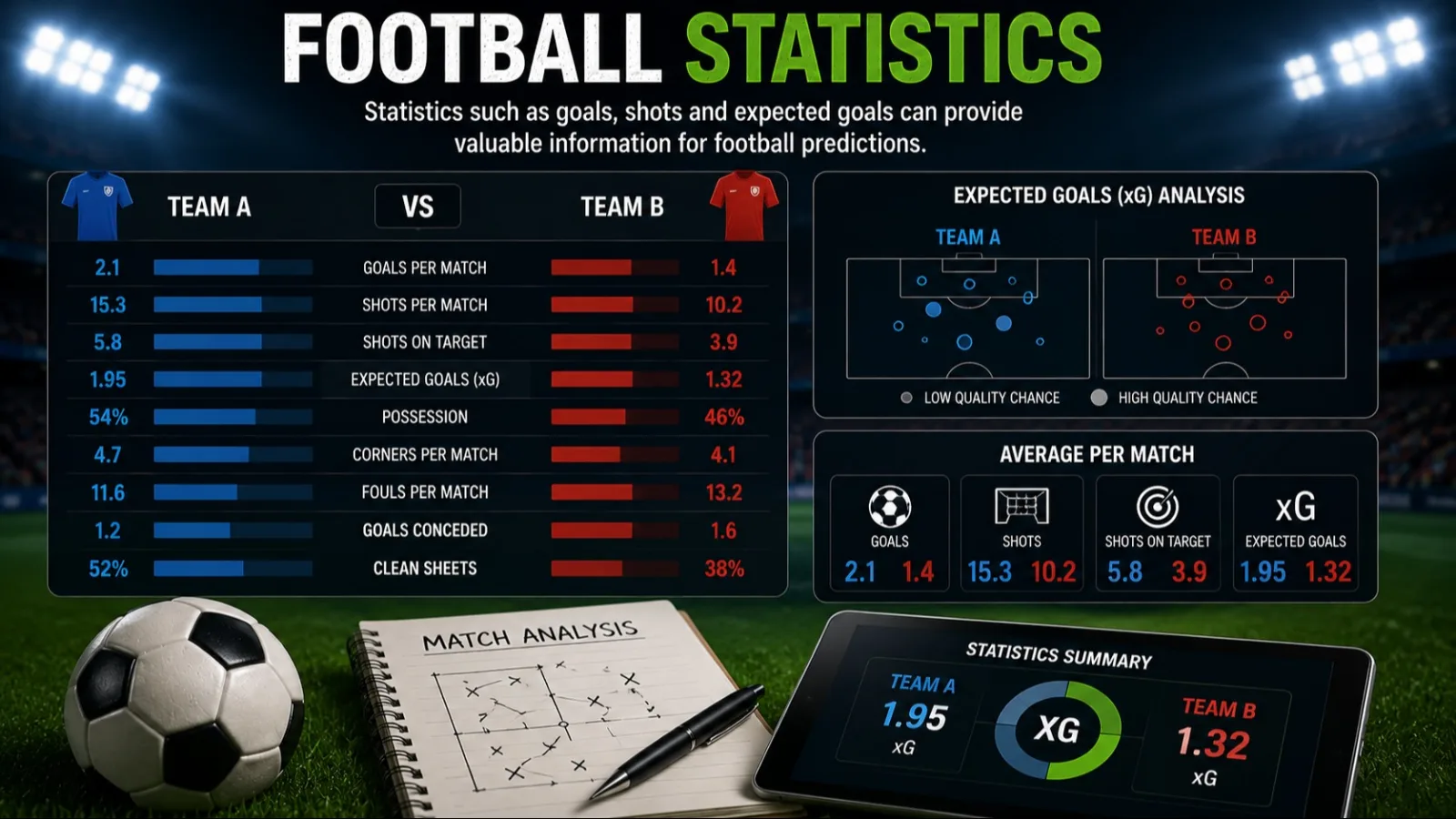 Statistics such as goals, shots and expected goals can provide valuable information for football predictions.
Previous meetings between two teams can provide additional information.
Analysts may check:
- Previous results
- Goals scored
- Goals conceded
- Home performances
- Recent meetings
For example, one team may have performed well against another opponent over several previous meetings.
However, head-to-head records should not be used alone.
Football teams change over time. Managers, players, tactics and overall team quality can all change, making older results less relevant.
6. Team Tactics and Playing Style
Football prediction is not only about numbers.
The way two teams play can also influence a match.
For example, one team may prefer attacking football and create many chances, while another may focus on defending and counter-attacking.
An analyst may consider whether one team's style is likely to create problems for the opponent.
Tactical changes can also affect predictions. A new manager may introduce a different system that changes how a team performs.
7. Expected Line-Ups
Knowing which players are likely to start can improve match analysis.
A team may have several important players available for one match but rest them for another fixture because of a busy schedule.
Analysts therefore pay attention to:
- Expected starting XI
- Key players
- Rotation
- Suspensions
- Injuries
- Recent substitutions
The final team line-up can sometimes cause betting odds to change shortly before kick-off.
8. Football Statistics and Data
Modern football prediction relies heavily on statistics.
Depending on the market, analysts may study:
- Possession
- Shots
- Shots on target
- Expected goals (xG)
- Corners
- Fouls
- Goals per match
- Clean sheets
- Defensive records
Expected goals, commonly known as xG, is particularly useful because it attempts to measure the quality of chances created rather than simply counting goals.
Statistics can provide a clearer picture of how teams are performing, but they should always be considered in context.
9. Betting Odds
Betting odds are another factor that can be considered when making football predictions.
Odds provide an indication of how the betting market views a particular outcome.
For example, a team priced at 1.50 is generally considered more likely to win than a team priced at 4.00.
However, odds are not guarantees.
Professional analysts may compare their own probability estimates with the available odds when looking for potential value.
10. Using Multiple Factors Together
The strongest football predictions are usually not based on one statistic.
Instead, analysts combine several factors.
For example:
Recent form + home performance + injuries + goals statistics + expected line-up + tactical analysis + odds
Looking at these factors together can provide a more complete picture of the match.
However, even a prediction supported by several strong factors can still lose.
How Football Prediction Sites Make Predictions
Football prediction websites may use a combination of statistics, historical data, algorithms and analyst opinions.
Some platforms use statistical models to calculate the probability of different outcomes. Others rely more heavily on human analysis.
A prediction platform such as Betzena can use football information and market analysis to provide users with predictions across different betting markets.
However, users should remember that predictions are not guarantees.
Can Football Predictions Be 100% Accurate?
No.
There is no reliable football prediction method that can correctly predict every match.
Football has too many variables and unexpected events.
A team can dominate a match and still lose. A late goal can change an entire prediction. A red card or penalty can also completely change the outcome.
This is why claims of 100% accurate football predictions should be treated with caution.
What Makes a Good Football Prediction?
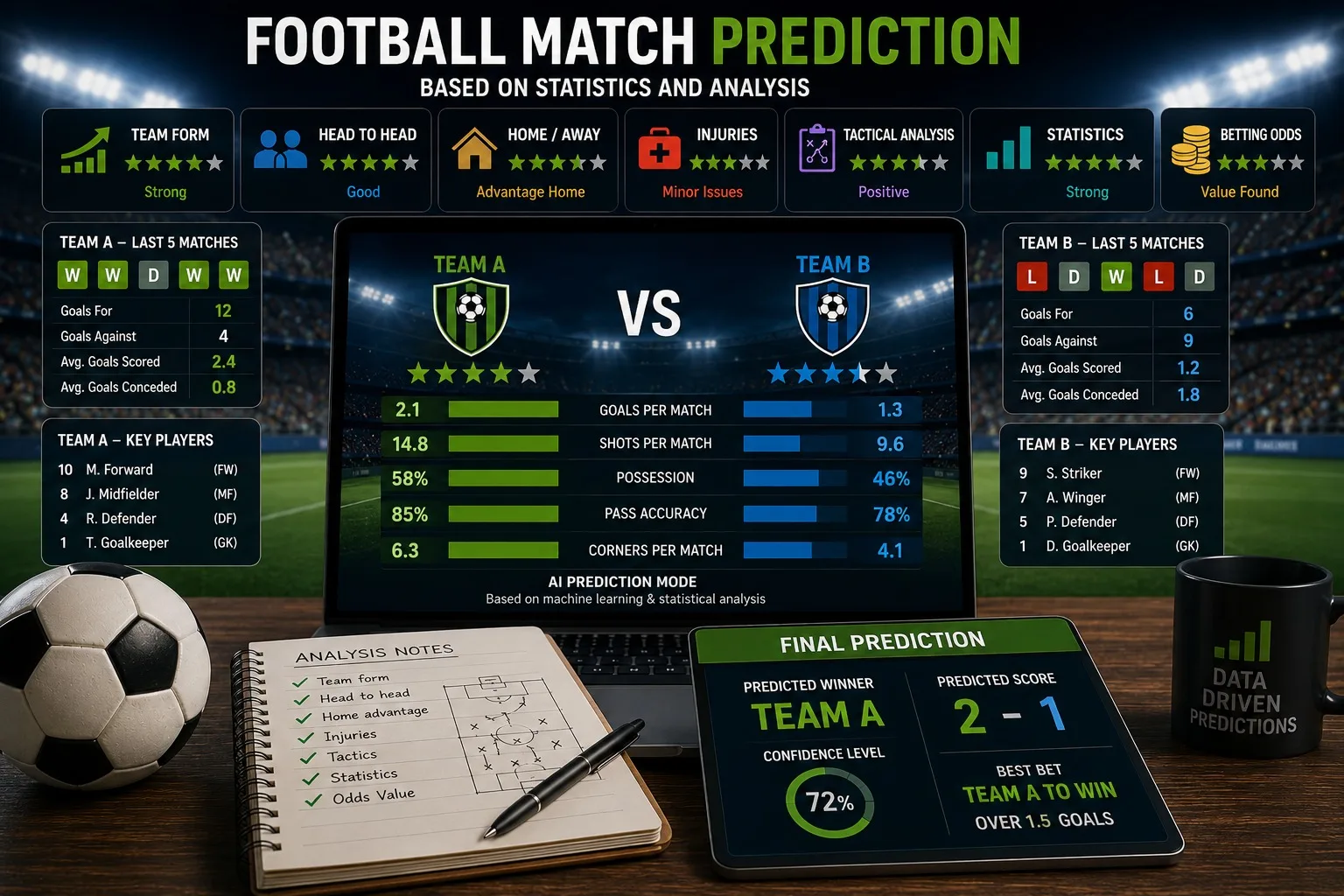 A football prediction brings together different pieces of information to form an informed assessment of the match.
A good prediction should be based on relevant and reliable information.
It should consider factors such as:
- Current team form
- Home and away records
- Player availability
- Goals and performance statistics
- Tactical approach
- Match importance
- Expected line-ups
- Available odds
Most importantly, a good prediction should acknowledge uncertainty rather than promise a guaranteed result.
Final Thoughts
Football predictions are made by analysing different factors that could influence the outcome of a match.
From recent form and team statistics to injuries, tactics, expected line-ups and betting odds, each piece of information can provide part of the overall picture.
However, analysis cannot remove the uncertainty of football.
The purpose of football prediction is not to guarantee a result but to make a more informed assessment of what could happen.
If you use football predictions for betting, always do your own research, manage your bankroll carefully and only bet money you can afford to lose.