Value Betting: How It Works
Value betting is one of the most important concepts for anyone who wants to understand football betting beyond simply choosing teams they think will win. Instead of asking only, “Which team will win?”, value betting asks a different question:
“Are the available odds higher than the actual chance of this outcome happening?”
This approach focuses on finding betting opportunities where the potential return may be greater than the risk suggested by the odds.
However, value betting does not mean guaranteed wins. A value bet can still lose. The idea is that if you consistently identify value over a large number of bets, the combined results may become more favourable over time.
What Is Value Betting?
 value betting strategy with football odds and money
Value betting compares the potential of a football outcome with the odds available.
Value betting involves identifying a selection where you believe the bookmaker's odds are higher than the true probability of the outcome.
For example, imagine you believe a football team has a 60% chance of winning a match.
The fair decimal odds based on that probability would be:
1 ÷ 0.60 = 1.67
If a bookmaker offers odds of 2.00, you may consider this a potential value bet because the available odds are higher than the odds suggested by your assessment.
The important point is that your probability estimate must be reasonable. Simply finding high odds does not mean you have found value.
How Do Betting Odds Relate to Probability?
Understanding probability is essential when learning value betting.
The basic formula for converting decimal odds into implied probability is:
Implied Probability = 1 ÷ Odds × 100
For example:
- Odds of 2.00 = 50%
- Odds of 2.50 = 40%
- Odds of 4.00 = 25%
- Odds of 5.00 = 20%
These percentages represent the probability implied by the odds before considering the bookmaker's margin.
If your own analysis suggests that an outcome has a higher probability than the odds imply, you may have identified potential value.
A Simple Value Betting Example
Imagine a match between Team A and Team B.
After studying recent form, injuries, home performance, goals and other statistics, you estimate that Team A has a 55% chance of winning.
The fair odds would be approximately:
1 ÷ 0.55 = 1.82
Now suppose the bookmaker offers odds of 2.20.
The bookmaker's odds imply a probability of:
1 ÷ 2.20 × 100 = 45.45%
Your assessment is 55%, while the odds imply about 45.45%.
This difference could represent potential value.
However, it does not mean Team A will definitely win that particular match.
Why Can Value Bets Lose?
This is one of the most important things beginners need to understand.
A value bet is not the same as a guaranteed winning bet.
Using the example above, you believe Team A has a 55% chance of winning. That also means there is approximately a 45% chance that Team A will not win according to your estimate.
The team could lose because of a red card, injury, poor finishing, penalty, tactical mistake or simply an unexpected performance.
Value betting is therefore based on long-term probability, not certainty in individual matches.
How Do You Find Value Bets?
Finding value requires research and analysis. There is no single statistic that can identify every value bet.
Some factors you can consider include:
- Recent team form
- Home and away performance
- Goals scored and conceded
- Injuries and suspensions
- Expected line-ups
- Head-to-head records
- Team motivation
- Strength of opposition
- Current betting odds
- Performance across different betting markets
The more accurate your assessment of the probability, the better your chances of identifying genuine value.
Compare Different Betting Markets
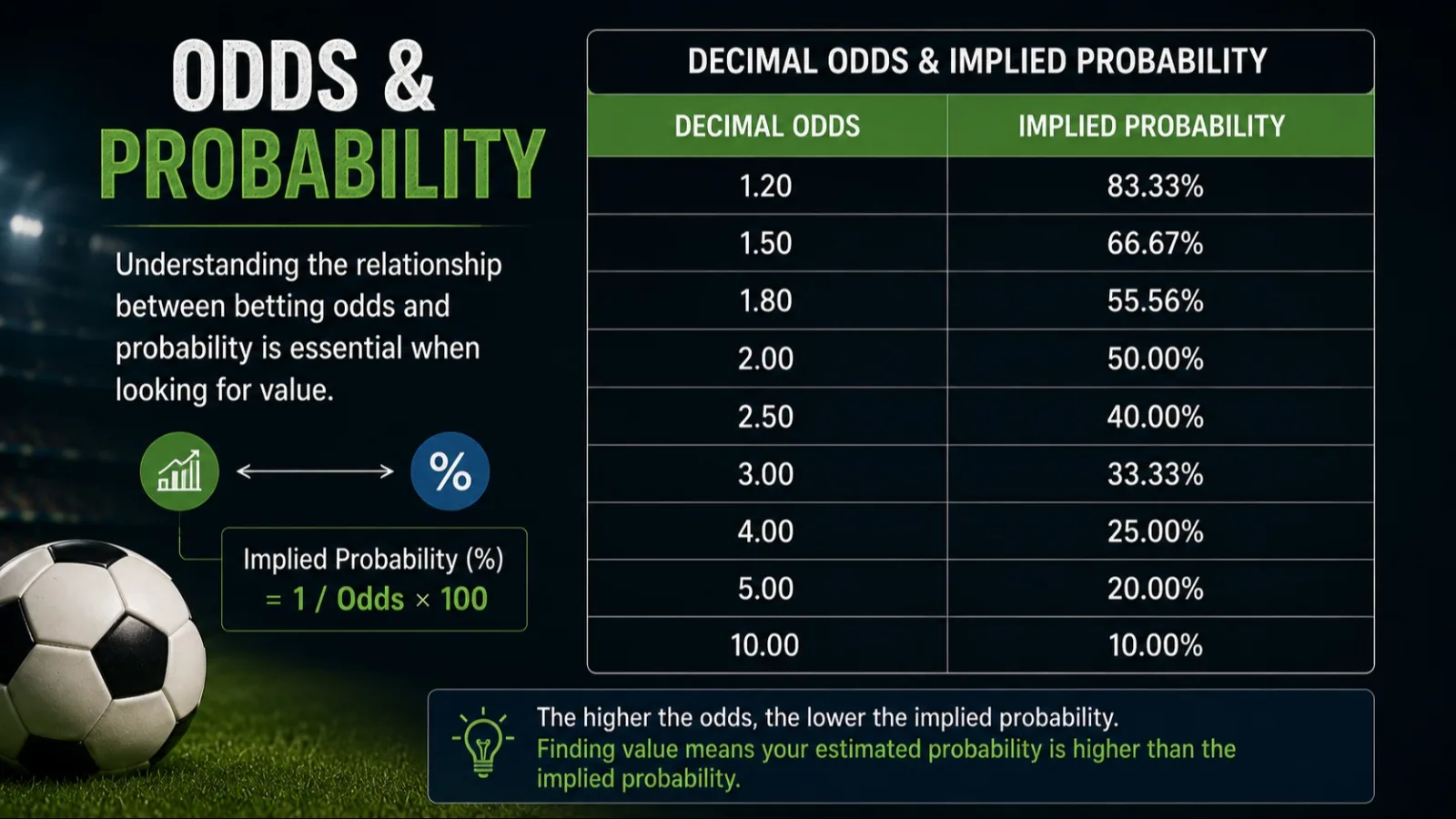 Understanding the relationship between betting odds and probability is essential when looking for value.
Value is not limited to the Match Result market.
You may find potential value in markets such as:
Over/Under Goals
If your analysis suggests that a match has a greater chance of producing several goals than the odds indicate, an Over Goals selection could offer potential value.
Both Teams to Score
A match involving two teams that regularly score and concede may provide opportunities in the BTTS market.
Double Chance
If you believe a team has a strong chance of avoiding defeat but the outright win looks less certain, Double Chance could be worth analysing.
Correct Score
Correct Score markets can have high odds, but they are much more difficult to predict. A bettor should be particularly careful when assessing whether the potential return justifies the probability.
Why Comparing Odds Matters
The same selection may have different odds across different bookmakers.
For example:
- Bookmaker A: 1.80
- Bookmaker B: 1.95
- Bookmaker C: 2.05
If you have already decided that the selection represents value, receiving 2.05 instead of 1.80 can make a significant difference over many bets.
This is why comparing available odds is an important part of value betting.
Even a small difference in odds can affect long-term returns.
What Is Expected Value?
Expected value, often called EV, is a way of estimating whether a bet could be profitable based on your probability assessment.
A simplified formula is:
EV = (Probability of Winning × Profit if You Win) − (Probability of Losing × Stake)
For example, suppose you estimate that a selection has a 55% chance of winning and the bookmaker offers odds of 2.20.
With a ₦10,000 stake:
- Potential profit = ₦12,000
- Probability of winning = 55%
- Probability of losing = 45%
The expected value would be:
(0.55 × ₦12,000) − (0.45 × ₦10,000) = ₦2,100
This example suggests a positive expected value based on your estimated probability.
However, the calculation is only as good as your probability estimate.
Value Betting Is Not About Finding High Odds
A common misunderstanding is that value betting means looking for very high odds.
That is not correct.
A selection at odds of 1.50 can potentially offer value if you believe its true probability is higher than the odds suggest.
Likewise, a selection at odds of 10.00 may not offer value if you believe its chance of winning is extremely small.
Value is about the relationship between probability and odds, not simply the size of the odds.
Keep Records of Your Bets
If you want to understand whether your value betting approach is working, keep detailed records.
Record:
- Match
- Date
- Market
- Selection
- Odds
- Your estimated probability
- Stake
- Result
- Profit or loss
After a significant number of bets, you can review the results and see whether your assessments are accurate.
Keeping records also helps you identify which leagues and markets you understand best.
Can Football Prediction Sites Help Find Value?
 Team form, goals, injuries and other statistics can help when estimating the probability of a football outcome.
Football prediction websites can provide useful information when analysing potential value bets.
For example, Betzena provides football predictions across different markets, which can give users additional selections and match information to consider.
However, a prediction site cannot guarantee that a selection offers value or that it will win.
The bettor still needs to consider the available odds and decide whether the prediction represents good value based on their own assessment.
Common Value Betting Mistakes
Beginners can make several mistakes when learning value betting.
Chasing High Odds
High odds do not automatically mean value.
Assuming Every Prediction Is Value
A prediction can be correct without offering value at the available odds.
Ignoring the Odds
Your probability assessment is only useful when compared with the actual odds available.
Using Poor Probability Estimates
If your estimate of the probability is inaccurate, your value calculation may also be inaccurate.
Expecting Immediate Profit
Value betting is based on long-term probability. A positive-value selection can lose, and several value bets can lose in a row.
Final Thoughts
Value betting is about finding situations where you believe the available odds are higher than the true probability of an outcome.
It requires more than simply choosing a football team you expect to win. You need to study the match, estimate the probability, compare it with the available odds and manage your stakes responsibly.
Most importantly, value betting does not remove risk. There are no guaranteed football bets, and even a genuine value bet can lose.
If you understand probability, compare odds carefully, keep accurate records and remain disciplined, value betting can give you a more structured way to approach football betting.
Always remember that football is unpredictable, and you should only bet money you can afford to lose.